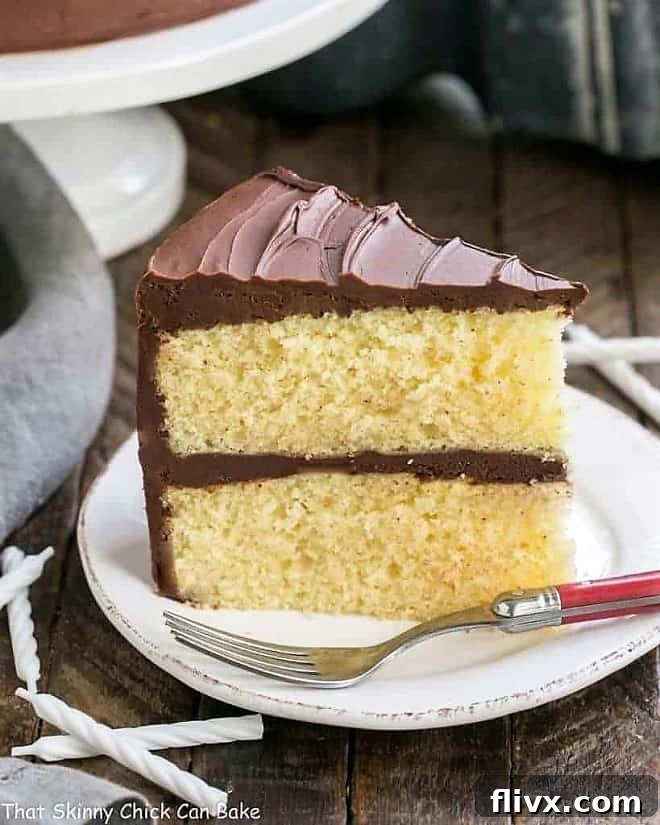
If you’re searching for that quintessential dessert to mark any special occasion, look no further than this exquisite Classic Yellow Cake with Rich Chocolate Frosting. This recipe delivers a tender, buttery crumb paired with a glossy, decadent frosting, making it the perfect centerpiece for birthdays, anniversaries, or simply a cherished family gathering. It’s the kind of cake that evokes warm memories and creates new ones, embodying comfort and celebration in every slice.
Originally baked for my daughter’s birthday, this beloved Yellow Cake Recipe from Scratch also served a delightful purpose in a virtual baby shower for a dear blogger friend, Angie of Big Bear’s Wife. Its timeless appeal makes it a versatile choice for any joyful event, promising to impress with its classic flavors and luxurious texture.
Why This Classic Yellow Cake is a Must-Bake
There’s a reason certain recipes become cherished family favorites, passed down through generations. This yellow cake, crowned with its fudgy chocolate frosting, is one such recipe. Here’s why it deserves a permanent spot in your baking repertoire:
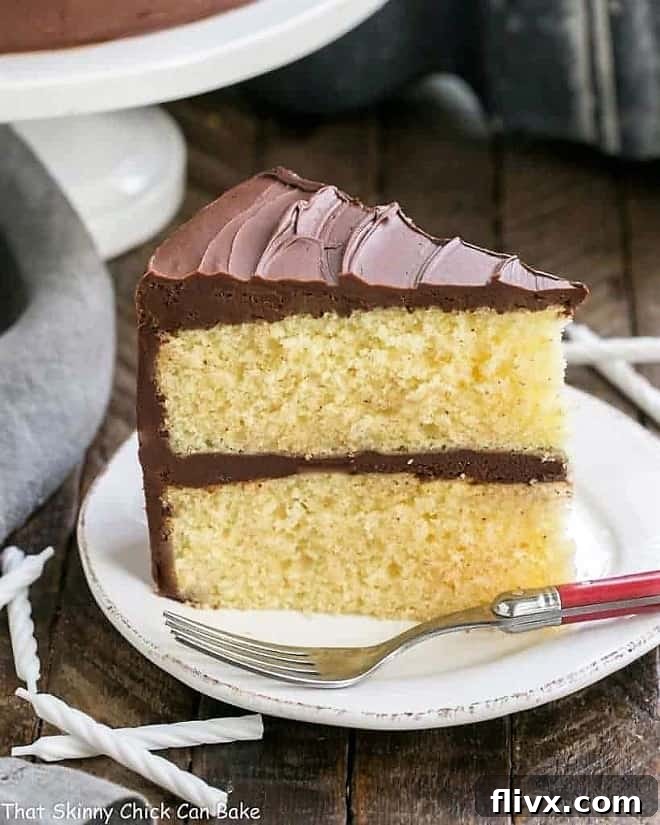
- The Ultimate Flavor Harmony: The combination of a moist, buttery yellow cake and a rich, fudgy chocolate frosting is an iconic pairing that has captivated dessert lovers for decades. The subtle notes of vanilla and butter in the cake provide a perfect canvas for the deep, intense flavor of real chocolate in the icing, creating a symphony of tastes that is utterly irresistible. It’s a nostalgic flavor that brings instant smiles.
- Superior Texture and Crumb: This cake boasts an exceptionally moist and tender crumb that practically melts in your mouth. Achieving this delicate balance relies on a careful selection of ingredients and precise techniques, ensuring a cake that is light yet substantial, with a fine texture that speaks of homemade perfection. Say goodbye to dry, crumbly cakes; this recipe guarantees a consistently delightful chew.
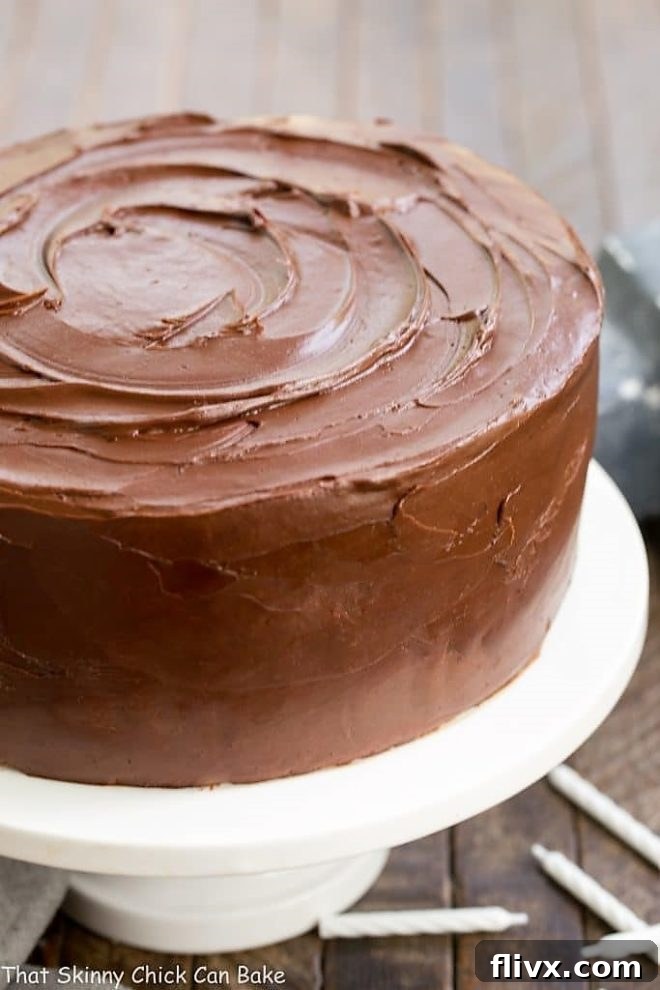
- Decadent, Glossy Chocolate Frosting: What truly elevates this cake is its incredible frosting. Made with a generous pound of high-quality semi-sweet chocolate and enriched with Dutch-process cocoa powder, this icing is nothing short of dreamy. It’s not just sweet; it’s a profound chocolate experience – glossy, smooth, and deeply flavorful, providing a luxurious finish that makes every bite a moment of pure bliss. This isn’t just any chocolate frosting; it’s a showstopper.
This classic pairing of the best yellow cake recipe and fudgy chocolate icing is a frequent request in my household, particularly for birthdays. I confess, as a food blogger, I’m always eager to experiment with new recipes, but some traditions are non-negotiable. Last time, I attempted to steer my husband towards a different cake for his birthday, only to be playfully threatened with a chainsaw as my own next birthday gift if he didn’t get his beloved yellow cake! After a bit of back-and-forth, punctuated by my own fits of hysterical laughter, I happily gave in. Some things, it seems, are simply worth repeating.
Expert Baking Tips for a Flawless Layer Cake
Crafting a truly beautiful and delicious layer cake involves a few key techniques. Follow these expert tips to ensure your yellow cake has a fine, tender crumb, perfectly even layers, and an absolutely marvelous frosting every time.
- Proper Pan Preparation is Paramount: To prevent your cakes from sticking and ensure easy release, begin by thoroughly buttering your cake pans. Then, line the bottoms with a round of parchment paper. Butter the top of the parchment as well, and finally, dust the entire interior lightly with flour. This creates a non-stick barrier that guarantees your beautiful layers will slide out effortlessly after baking.
- Achieve Even Layers with Precision: For uniform cake layers that stack beautifully, use a kitchen scale to divide your batter evenly between the prepared pans. This simple step ensures each layer bakes to the same depth and density, resulting in a professional-looking cake that’s consistently tender from top to bottom.
- Master Your Mixing Technique: When preparing the batter, always use the paddle attachment on your stand mixer, not the whisk. The paddle prevents excessive gluten formation, which can lead to a tougher cake, and minimizes aeration of the batter. This technique is crucial for achieving that coveted fine, delicate crumb that distinguishes an exceptional yellow cake.
- Alternate Wet and Dry Ingredients: The method of alternately adding wet and dry ingredients is vital for a tender cake. This process allows the flour to envelop the fat particles more effectively, leading to a more emulsified batter and ultimately a softer, more tender finished product. Begin and end with the dry ingredients for best results.
- Bake Just Until Done (Don’t Overdo It!): Overbaking is the enemy of a moist cake. Start checking your cakes a few minutes before the timer suggests. The cake is ready when a toothpick inserted into the center comes out clean or with a few moist crumbs attached. The top should be golden brown and spring back lightly when touched. Remove from the oven promptly to preserve moisture.
- Cooling is Crucial for Structure: Once baked, let the cakes cool in their pans for about 10-15 minutes on a wire rack. This allows them to firm up slightly before you attempt to remove them. After this initial cooling, gently invert the cakes onto cooling racks, peel off the parchment paper, and let them cool completely to room temperature before even thinking about frosting. Rushing this step can lead to a crumbly mess.
- Bring Ingredients to Room Temperature: Ensure your butter, eggs, and milk are all at room temperature before you start mixing. Room temperature ingredients emulsify more effectively, creating a smoother, more uniform batter that bakes up beautifully and holds more air, resulting in a lighter texture.
- Sift Your Dry Ingredients: Sifting your flours, baking powder, and salt together isn’t just for removing lumps; it also aerates the dry ingredients, ensuring they are evenly distributed. This contributes to a lighter cake texture and prevents pockets of leavening agents.
The History and Essence of Yellow Cake
The yellow cake is more than just a dessert; it’s a piece of culinary history, a symbol of American comfort and celebration. Its origins trace back to the 19th century, a transformative era in baking when innovations like baking powder and baking soda became widely accessible. Before these chemical leavening agents, cakes relied heavily on yeast or laborious egg-whipping methods. The introduction of baking powder offered a simpler, more consistent way to achieve a light, airy crumb, paving the way for cakes as we know them today.
Often dubbed a “celebration cake” in its early days, the yellow cake quickly gained popularity due to its rich flavor, derived primarily from whole eggs and butter, giving it its characteristic golden hue. It is believed to have evolved from denser European pound cakes, adapting to new ingredients and methods to become the tender, fluffy confection we adore. Its versatility made it a favorite for all occasions, from simple family dinners to grand festivities. The yellow cake’s enduring appeal lies in its straightforward deliciousness, making it a foundation for countless flavor combinations, with chocolate frosting remaining its most iconic partner.
Crafting the Perfect Chocolate Frosting
While the yellow cake itself is a masterpiece, the chocolate frosting is what truly completes this classic duo. Our recipe calls for a “double dose” of chocolate for a reason: combining high-quality semi-sweet chocolate with Dutch-process cocoa powder creates a depth of flavor and a luscious texture that’s unmatched. The semi-sweet chocolate provides richness and a smooth mouthfeel when melted, while Dutch-process cocoa offers a darker color and a less acidic, more mellow chocolate taste, enhancing the overall intensity without bitterness. The result is a frosting that is not only incredibly delicious but also beautifully glossy and spreads like a dream, making your cake look as good as it tastes.
Perfect Pairings for Your Celebration Cake
This classic yellow cake with chocolate frosting is the star of any celebration, but a well-rounded menu can elevate the entire experience. When planning for a party, consider offering a variety of complementary dishes to delight your guests. For appetizers, think light and refreshing options like a creamy grape salad, delicate mini chicken and waffles, or flavorful deviled eggs. Main courses could range from hearty casseroles to elegant skewers with a rich sauce, ensuring there’s something for everyone. And for drinks, a vibrant fruit punch or a celebratory mimosa bar always adds a festive touch. This cake also pairs wonderfully with a good cup of coffee or a cold glass of milk, making it suitable for both casual and formal settings.
Appetizers & Salads:
- Refreshing Fruit Punch
- Creamy Grape Salad
- Savory Mini Chicken and Waffles
- Classic Deviled Eggs
Entrees:
- Comforting Casseroles
- Flavorful Chicken Skewers with Peanut Sauce
- Gourmet Ham and Cheese Sliders
Other Desserts to Complement:
- Indulgent Brownie-Cookie Hybrids (Brookies)
- Sweet and Salty Caramel Corn
- Rich Caramel Pecan Cheesecake
- Light Chocolate Chip Clouds
- Zesty Lemon Donuts with Raspberry Glaze
- Spiced Pumpkin Cheesecake Brownie Bars
- Classic Yellow Butter Cake with Fudgy Chocolate Icing (of course!)
- An Elegant White Birthday Cake
For a more portable and equally delightful dessert, you’ll also love our Yellow Cupcakes with Ganache Frosting Recipe!
Frequently Asked Questions About Yellow Cake
What Flavor is Yellow Cake?
Yellow cake is primarily defined by its rich, buttery, and vanilla flavor profile. Unlike white cake, which uses only egg whites, yellow cake incorporates whole eggs (including the yolks), lending it a richer taste and its characteristic golden hue. This makes for a milder, almost neutral yet deeply satisfying cake base. It often has a subtle custard-like essence, especially when paired with quality butter and vanilla extract, which is precisely why it harmonizes so exquisitely with a robust chocolate frosting.
When Was the Yellow Cake Invented?
The concept of the yellow cake, as we understand it today, emerged in the 1800s. This period marked a significant turning point in baking with the widespread availability and use of chemical leavening agents such as baking powder and baking soda. These ingredients offered a more consistent and reliable rise compared to the earlier reliance on yeast or laborious whipping of eggs. Initially known as a “celebration cake,” it is believed that the yellow cake may have evolved from traditional British pound cakes, adapting to the new world of baking science to become the beloved tender, buttery cake that remains a staple for festivities.
What is the Difference Between Yellow Cake and White Cake?
The primary distinction between yellow cake and white cake lies in their egg content. Yellow cakes are made with whole eggs, including the yolks, which contribute to their characteristic golden color, richer flavor, and denser, moister crumb. White cakes, on the other hand, use only egg whites, resulting in a lighter color, a delicate, often more ethereal texture, and a milder flavor profile. While both are classic choices for celebrations, the yellow cake offers a comforting richness and buttery depth that stands out.
Can I Make This Yellow Cake Ahead of Time?
Absolutely! This yellow cake is an excellent make-ahead dessert, perfect for reducing stress before a big event. You can bake the cake layers up to 2-3 days in advance. Once completely cooled, wrap each layer tightly in plastic wrap and then in aluminum foil to prevent them from drying out. Store them at room temperature or in the refrigerator. The frosting can also be made a day in advance and stored in an airtight container in the refrigerator; just let it come to room temperature and give it a quick whip before frosting your cake.
How Should I Store Leftover Yellow Cake?
To keep your yellow cake with chocolate frosting fresh, store it at room temperature under a cake dome or in an airtight container for up to 3-4 days. The butter in the frosting acts as a natural preservative. If you need to store it longer, or if your kitchen is particularly warm, you can refrigerate it for up to a week. Just be sure to bring it back to room temperature for at least an hour before serving to ensure the cake is soft and the frosting is creamy. For longer storage, individual slices can be wrapped and frozen for up to 2-3 months.
Stay in touch through social media @ Instagram, Facebook, and Pinterest. Don’t forget to tag me when you try one of my recipes! And if you love the results, please give it a 5-star rating in the recipe card.
Yellow Butter Cake Recipe with Chocolate Icing
40 minutes
35 minutes
1 hour 15 minutes
12
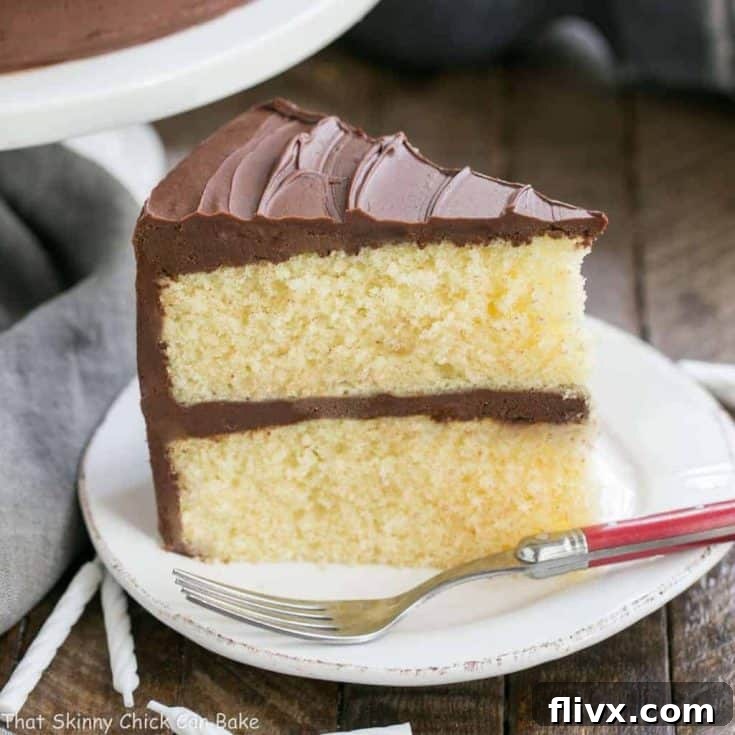
The classic combination of yellow butter cake with chocolate icing! Perfect for birthdays and any festive occasion, this recipe delivers a moist, tender crumb and a rich, fudgy frosting that will become an instant family favorite.
Rating: 4.6 out of 5 stars from 27 reviews.
Ingredients
For Cake:
- 1 cup butter (2 sticks), at room temperature plus more for greasing pans
- 1 ½ cups all-purpose flour, plus more for dusting pans
- 1 ½ cups cake flour
- 1 tablespoon baking powder
- ½ teaspoon salt
- 1 ¾ cups granulated sugar
- 4 large eggs, at room temperature
- 2 teaspoons pure vanilla extract
- 1 ¼ cups whole milk, at room temperature
For Frosting:
- 1 pound semi-sweet chocolate, finely chopped
- 6 tablespoons Dutch-process cocoa powder
- 6 tablespoons boiling water
- 1 ½ cups unsalted butter (3 sticks), at room temperature
- ½ cup powdered sugar, sifted
- 1 teaspoon pure vanilla extract
Instructions
- Prepare the Pans and Dry Ingredients: Preheat your oven to 350ºF (175ºC). Generously butter two 9-inch round cake pans. Line the bottoms of the pans with parchment paper rounds, then butter the parchment paper and dust with a light coating of flour, tapping out any excess. Set aside. In a medium bowl, whisk together the all-purpose flour, cake flour, baking powder, and salt until well combined. Set aside.
- Cream Butter and Sugar: In the bowl of a stand mixer fitted with the paddle attachment, beat the room temperature butter and granulated sugar on medium-high speed until the mixture is light, pale, and fluffy, about 3-4 minutes. Scrape down the sides of the bowl as needed to ensure even mixing.
- Add Eggs and Vanilla: Reduce the mixer speed to low. Add the eggs one at a time, beating well after each addition until fully incorporated. Mix in the vanilla extract.
- Combine Wet and Dry Ingredients: With the mixer on low speed, gradually add the flour mixture in three parts, alternating with the milk, beginning and ending with the flour mixture. Beat until just combined after each addition, being careful not to overmix. Overmixing can develop gluten, leading to a tougher cake.
- Fill Pans and Bake: Divide the batter evenly between the two prepared cake pans. For precise layers, use a kitchen scale. Smooth the tops with an offset spatula. Bake for 30-35 minutes, or until the cakes are golden brown and a wooden skewer or toothpick inserted into the center comes out clean or with a few moist crumbs attached.
- Cool the Cakes: Let the cakes cool in their pans on a wire rack for about 10-15 minutes. This allows them to set before handling. Then, carefully invert the cakes onto the cooling racks, peel off the parchment paper, and let them cool completely to room temperature before frosting.
- Prepare for Frosting: Ensure the cakes are completely cool before you begin making the icing. This prevents the frosting from melting and sliding off the warm cake.
- Melt Chocolate for Frosting: Gently melt the chopped semi-sweet chocolate in a microwave-safe bowl, heating in 30-second increments and stirring well after each interval, until the chocolate is completely melted and smooth. Alternatively, you can use a double boiler. Set the melted chocolate aside to cool to room temperature (this usually takes about 15-20 minutes).
- Dissolve Cocoa: In a small bowl, stir together the Dutch-process cocoa powder and boiling water until the cocoa is fully dissolved and forms a smooth, thick paste. Set aside to cool slightly.
- Cream Butter and Powdered Sugar: In the clean bowl of your stand mixer fitted with the paddle attachment, beat the room temperature butter and sifted powdered sugar on medium-high speed until light and fluffy, about 2-3 minutes.
- Combine Frosting Ingredients: Add the vanilla extract and mix until combined. Then, gradually add the cooled melted chocolate to the butter mixture, beating until well combined and smooth.
- Add Cocoa Mixture: Finally, add the cooled cocoa mixture to the frosting and beat on medium speed until the frosting is smooth, glossy, and light. If the frosting seems too thick, you can add a tablespoon of milk at a time until it reaches your desired consistency.
- Frost the Cake: Frost the cooled cake layers immediately after making the frosting for the best, smoothest results. Spread an even layer of frosting between the two cake layers, then frost the top and sides of the cake. Decorate as desired.
Notes
Adapted from Martha Stewart’s Baking Handbook. For best results, use high-quality butter and chocolate.
Recommended Products
As an Amazon Associate and member of other affiliate programs, I earn from qualifying purchases.
- 9-inch Parchment Rounds
- 9-inch USA Pan Bakeware Round Cake Pan
- KitchenAid KSM150PSER Artisan Tilt-Head Stand Mixer with Pouring Shield, 5-Quart, Empire Red
Nutrition Information:
Yield:
12
Serving Size:
1 slice
Amount Per Serving:
Calories: 821Total Fat: 52gSaturated Fat: 32gTrans Fat: 2gUnsaturated Fat: 17gCholesterol: 166mgSodium: 557mgCarbohydrates: 87gFiber: 3gSugar: 55gProtein: 8g
Thatskinnychickcanbake.com occasionally offers nutritional information for recipes contained on this site. This information is provided as a courtesy and is an estimate only. This information comes from online calculators. Although thatskinnychickcanbake.com attempts to provide accurate nutritional information, these figures are only estimates. Varying factors such as product types or brands purchased can change the nutritional information in any given recipe. Also, many recipes on thatskinnychickcanbake.com recommend toppings, which may or may not be listed as optional and nutritional information for these added toppings is not listed. Other factors may change the nutritional information such as when the salt amount is listed “to taste,” it is not calculated into the recipe as the amount will vary. Also, different online calculators can provide different results. To obtain the most accurate representation of the nutritional information in any given recipe, you should calculate the nutritional information with the actual ingredients used in your recipe. You are solely responsible for ensuring that any nutritional information obtained is accurate.
HOW MUCH DID YOU LOVE THIS RECIPE?
Please leave a comment on the blog or share a photo on Pinterest