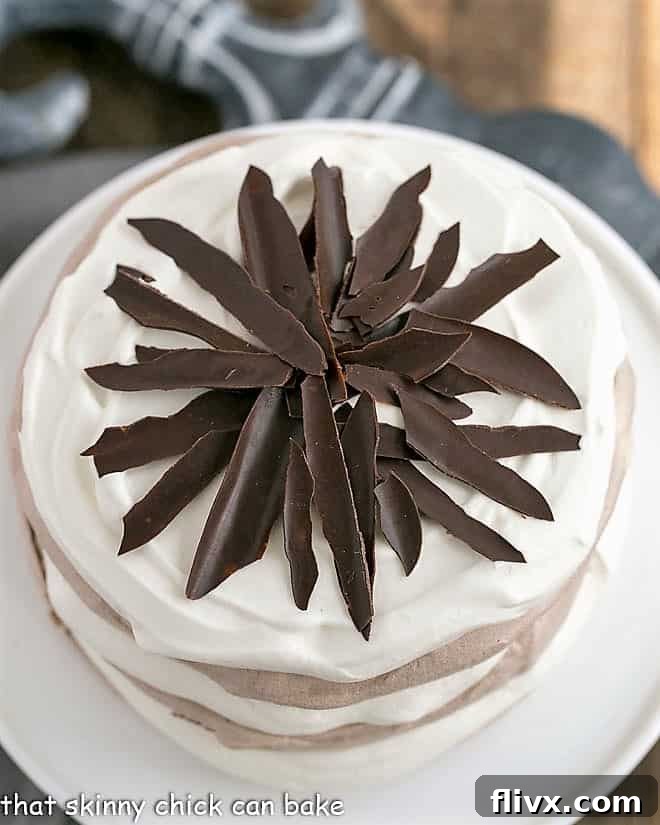
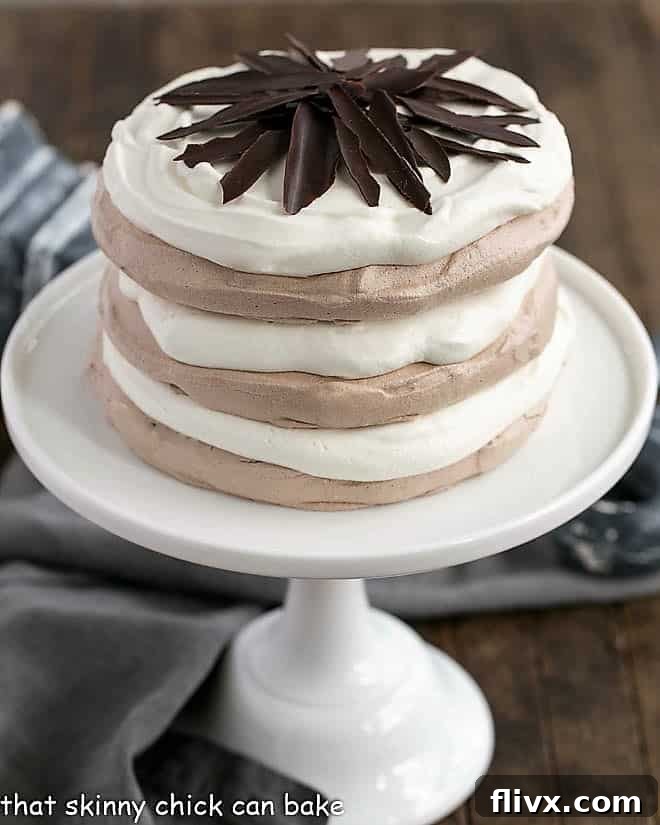
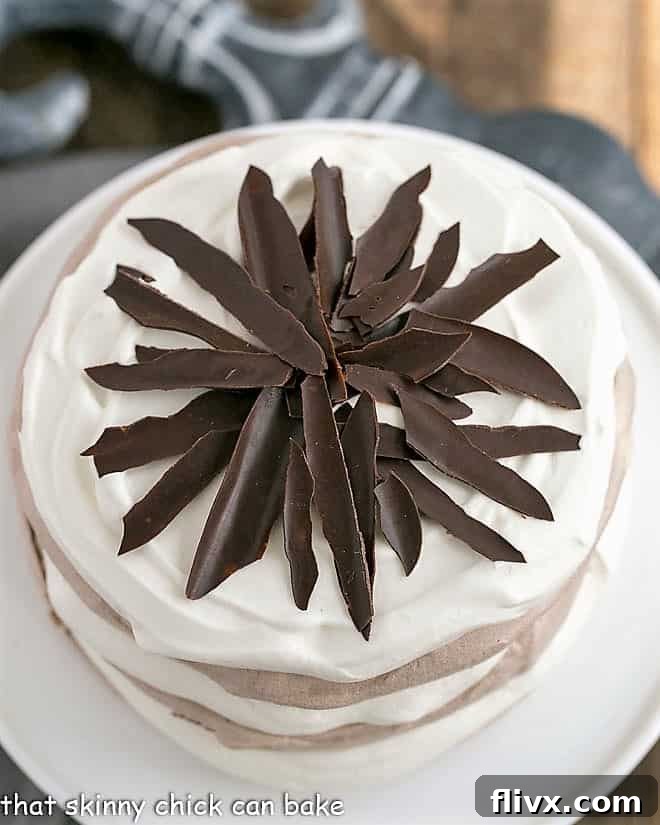
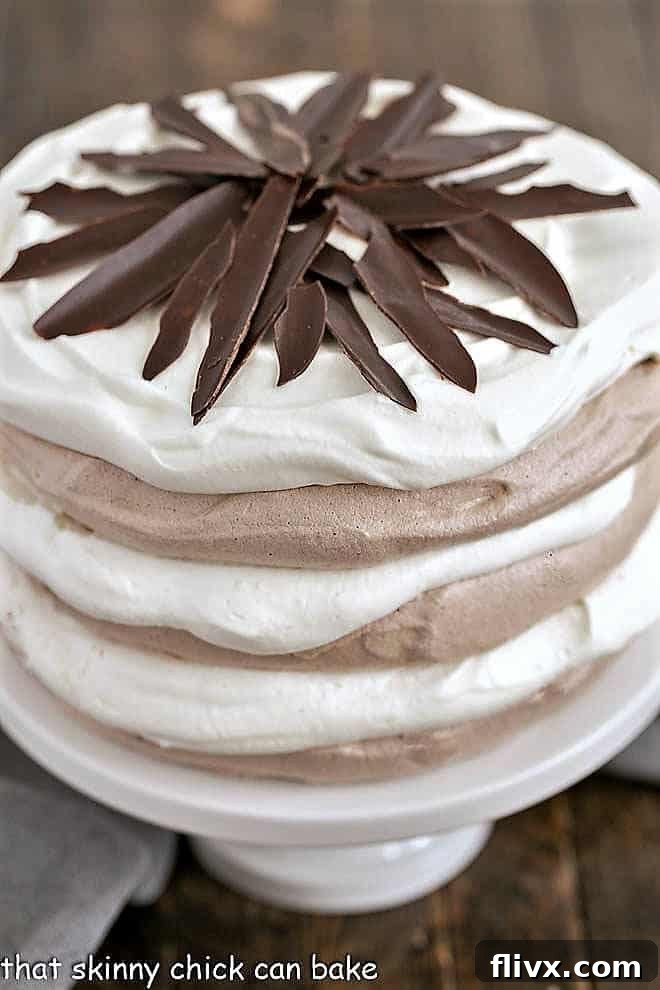
Step into a world of exquisite desserts with this magnificent Layered Chocolate Meringue Cake. Born from the pages of a dreamy magazine, this recipe transforms simple ingredients into an unforgettable culinary masterpiece. Imagine three delicate, cocoa-kissed pavlova layers, each baked to airy perfection, then generously filled with swirls of sweet, ethereal whipped cream. Crowning this tower of delight are elegant chocolate shards, adding a sophisticated touch and an extra layer of textural intrigue. This isn’t just a dessert; it’s a statement, a showstopper that promises to impress with its stunning appearance and melt-in-your-mouth flavor. Perfect for any special occasion or simply to elevate an ordinary day, this chocolate pavlova cake redefines elegance in baking.
Why This Layered Chocolate Pavlova Cake Deserves a Spot on Your Table
This dessert isn’t just beautiful; it’s a revelation, especially for those who appreciate chocolate but prefer a lighter touch. It’s an ideal choice for the discerning palate, like my daughter’s, who often finds traditional chocolate cakes too rich or their frostings overwhelmingly intense. This gluten-free chocolate dessert strikes a perfect balance, offering deep chocolate flavor without the heavy aftertaste.
- A Symphony of Textures and Flavors: The cocoa pavlovas provide a delightful crunch on the outside, giving way to a soft, marshmallowy interior. This is beautifully complemented by the smooth, sweet vanilla whipped cream, creating a contrast that’s simply divine. The subtle hint of cocoa in the meringue layers ensures a satisfying chocolate experience without being overly saccharine, making it universally appealing.
- Effortlessly Elegant and Refreshing: Unlike many dense desserts, this chocolate meringue cake is wonderfully cool and light. It’s an impressive treat that feels luxurious yet refreshing, making it especially perfect for warm weather gatherings or as a light finish to a hearty meal. Its architectural beauty makes it a natural centerpiece for any celebration, from birthdays to holiday feasts.
- Simply Scrumptious and Luscious: Every bite of this layered dessert is a testament to its light and luscious nature. It’s a dessert that speaks of sophistication and culinary artistry, yet is surprisingly approachable to make. The airy meringues, the creamy filling, and the decorative chocolate shards come together to create a dessert that is not only delicious but also visually stunning, promising to leave a lasting impression on your guests.
Mastering Meringues and Pavlovas: Expert Tips for Success
While often used interchangeably, meringues and pavlovas have distinct characteristics. This recipe, with its soft, chewy center, leans towards a pavlova. Regardless of terminology, achieving the perfect airy base requires attention to detail. Here are essential tips to ensure your layered chocolate pavlova cake turns out flawlessly every time.
The Eggs: Foundation of Perfect Meringue
The success of your meringue hinges significantly on the quality and preparation of your egg whites. These foundational steps are crucial for achieving that desired volume and stable structure.
- PRO-Tip: Room Temperature is Key: Your egg whites absolutely must be at room temperature before whipping. This is a non-negotiable step for maximum volume and stability. Room temperature whites whip up more easily and achieve a greater volume than cold whites. However, separating eggs is far simpler when they are cold, as the yolks are less likely to break.
- Strategic Egg Separation: To navigate this, I recommend separating your eggs straight out of the refrigerator. Once separated, cover the whites with plastic wrap and let them sit on the counter for 30-60 minutes to reach room temperature. Don’t discard those yolks! They’re perfect for enriching ice creams, luscious puddings, or classic custards like crème brûlée.
- The Three-Bowl Method for Purity: Fat is the enemy of perfectly whipped egg whites. Even a minuscule amount of yolk can prevent your whites from reaching stiff peaks. To safeguard against this, employ the “three-bowl method”: one bowl for your clean egg whites, one for the yolks, and a small, separate bowl to crack each egg into and separate the white. After successfully separating a white into this small bowl, transfer it to the main “whites” bowl, and then move the yolk to its designated bowl. Repeat for each egg.
- Contamination Control: If a yolk happens to break in your separating bowl, do not add that white to your clean batch. Set it aside for scrambled eggs or another use, grab another perfectly clean bowl, and continue the separation process. This vigilance ensures every white is pristine.
- Spotless Equipment is Paramount: Your mixing bowls and beaters must be scrupulously clean and absolutely free of any grease or fat residue. I always run my mixer bowl and beaters through the dishwasher before making meringues to ensure they pass this critical test. Any lingering fat, whether from prior cooking or even a tiny speck of yolk, will prevent your egg whites from whipping properly, resulting in a flat, unworkable meringue.
Whipping the Egg Whites: Achieving Glossy Peaks
Once your eggs are ready, the whipping process requires a delicate touch and a bit of patience to transform them into a glossy, stable meringue.
- PRO-Tip: The Magic of Superfine Sugar: Using superfine sugar (sometimes labeled as castor sugar) is highly recommended. Brands like Domino’s often offer this. Its finer granules dissolve more readily into the egg whites, resulting in a smoother, more stable meringue without a gritty texture. While not strictly required, it significantly enhances the final product.
- Beyond Homemade Superfine: While it might be tempting to whiz granulated sugar in a food processor to create your own superfine version, research suggests this homemade alternative can be subpar. The processed sugar grains can have sharper edges that don’t dissolve as smoothly, potentially affecting the meringue’s texture. Sticking to commercially produced superfine sugar is generally best.
- Slow and Steady Sugar Addition: Introduce the sugar slowly, about two tablespoons at a time, allowing the egg whites ample opportunity to incorporate and dissolve it. Continuously beat the whites as you add the sugar. To check for dissolution, rub a tiny amount of the meringue mixture between your thumb and index finger. If it feels gritty, continue mixing for a bit longer. However, err on the side of a slight grit rather than overbeating the meringue, which can lead to a dry, brittle consistency.
- Visual Cues for Perfection: Your meringue is perfectly whipped when it appears thick, incredibly glossy, and holds stiff peaks. When you lift the beaters, the peaks should stand tall and firm, with a slight curl at the very tip, indicating a stable and airy structure ready for baking.
Baking Your Meringue: Low and Slow Perfection
Baking meringues, especially pavlovas, is a gentle art. The key is a low temperature and a long, slow drying process to achieve that signature crisp exterior and chewy interior.
- The Gentle Heat Method: Unlike typical cakes or cookies, meringues are baked at a significantly lower temperature. This allows them to dry out slowly and evenly, preventing them from browning too quickly or collapsing. Expect your meringue to be in the oven for approximately three hours during the initial baking phase.
- The Crucial Drying Period: Following the baking time, an equally important three-hour cooling and drying period inside the turned-off oven is required. This slow cool-down prevents thermal shock, which can cause the pavlova to crack excessively or deflate. During this critical time, it is imperative NOT to accidentally turn the oven back on or open the oven door frequently.
- PRO-Tip: The Oven Door Reminder: To safeguard your delicate pavlovas during the drying phase, place a visible Post-It note on your oven door. This simple reminder will prevent anyone from inadvertently using or opening the oven while your pavlovas are inside, preserving their structure and texture.
- Shaping with Precision: The templates you draw on each piece of parchment paper are invaluable for creating uniform, perfectly sized meringue layers. These guides ensure that each pavlova disc is consistent, making assembly of your layered cake much easier and visually appealing. An offset spatula is an excellent tool for smoothly spreading and shaping the meringue within your drawn circles, creating neat edges and even tops.
- Baking Sheet Flexibility: Don’t worry if you only have two baking sheets. You can easily bake one meringue on one sheet and the other two on the second, rotating them halfway through the baking time if needed to ensure even cooking. The low temperature makes this flexible without compromising quality.
Serving Your Meringue Cake: Presentation and Ease of Slice
Presenting and serving this magnificent cake can be as important as baking it. Here are some tips to ensure a beautiful and effortless experience.
- Choose Your Serving Plate Wisely: While a cake stand makes for a stunning photographic display, slicing this delicate, layered dessert on a pedestal stand can be challenging. For practical serving, I highly recommend transferring the assembled cake to a flat cake plate. This provides a stable surface, making it much easier to cut neat slices.
- PRO-Tip: The Hot Knife Trick for Clean Slices: After learning the hard way (resulting in a bit of a cake smash and whipped cream oozing everywhere during my first attempt), I discovered an invaluable trick for slicing layered meringue cakes: a heated serrated knife. Simply run a serrated knife under very hot water for about 30 seconds, then quickly dry it off before making each cut. The warm blade glides through the crisp meringue and creamy layers effortlessly, resulting in beautifully clean slices without crushing the delicate structure.
Frequently Asked Questions About Meringue and Pavlova
While both meringues and pavlovas are exquisite desserts primarily made from whipped egg whites and sugar, they are not entirely interchangeable culinary terms. A classic meringue, such as those used for cookies or pie toppings, is typically crisp and brittle throughout. In contrast, a pavlova, named after the Russian ballerina Anna Pavlova, boasts a distinct texture: a wonderfully crisp outer shell that gives way to a soft, marshmallow-like, and delightfully chewy interior. This textural contrast is what truly sets a pavlova apart and makes it such a unique and beloved dessert.
Strictly adhering to culinary definitions, this elegant layered dessert is indeed crafted from three distinct pavlovas, making it a “Chocolate Pavlova Cake.” The key differentiator lies in the ingredients. Traditional meringues typically consist solely of egg whites and sugar. Pavlovas, however, include additional ingredients like cornstarch and an acidic component (such as vinegar or lemon juice). These additions are crucial for achieving the characteristic marshmallow-like or “squidgy” (as Nigella Lawson might describe it) center that defines a true pavlova. In this particular recipe, cornstarch and lemon juice are incorporated to provide the essential acidity required for that classic pavlova texture. While some may still refer to it casually as a meringue cake, its composition firmly places it in the pavlova category, ensuring that delightful crisp-chewy contrast.
Customizing Your Layered Chocolate Pavlova Cake
While this Layered Chocolate Meringue Cake is perfect as is, it also offers fantastic opportunities for customization. Feel free to adapt it to your taste preferences or the occasion.
- Berry Bliss: Incorporate fresh berries between the layers of whipped cream. Raspberries, strawberries, or even mixed berries add a wonderful tartness that complements the rich chocolate and sweet cream.
- Nutty Notes: For an added crunch and depth of flavor, sprinkle toasted chopped nuts like pistachios, almonds, or hazelnuts between the layers or over the top.
- Liqueur Lift: Infuse the whipped cream with a subtle hint of your favorite liqueur. A touch of raspberry liqueur, coffee liqueur, or even orange liqueur can elevate the flavor profile.
- Chocolate Variations: Experiment with different types of chocolate shards for garnishing. Dark chocolate provides a bitter contrast, milk chocolate adds sweetness, and white chocolate offers a creamy, milder flavor. You could also dust with cocoa powder or finely grated chocolate instead of shards.
- Citrus Zest: A little citrus zest (orange or lime) mixed into the whipped cream can provide a bright, unexpected twist that cuts through the richness beautifully.
Troubleshooting Common Meringue Problems
Meringue can be a bit finicky, but understanding common issues can help you avoid them or fix them if they arise.
- Meringue Won’t Stiffen: This is almost always due to fat contamination (a tiny bit of egg yolk, grease on equipment) or very old egg whites. Ensure everything is sparkling clean and use fresh eggs. Humidity can also play a role, so try to bake on a dry day.
- Meringue Collapses or Weeps: Over-beating can make meringue brittle and prone to collapse. Undissolved sugar can also cause weeping (sugar syrup seeping out). Ensure sugar is added slowly and dissolved, and avoid sudden temperature changes after baking.
- Too Brown or Too Soft: If your meringue browns too much, your oven temperature might be too high. If it’s too soft in the middle (and not intentionally chewy like a pavlova), it needs more baking time at a low temperature, or more drying time in the oven.
- Cracked Surface: Some cracking is natural for pavlovas, giving them rustic charm. Excessive cracking can be due to too high a temperature, opening the oven door too often, or rapid cooling.
Storage Tips for Your Chocolate Meringue Cake
To enjoy your exquisite Layered Chocolate Meringue Cake at its best, proper storage is essential.
- Unassembled Layers: Individual pavlova layers, once fully cooled and dried, can be stored in an airtight container at room temperature for up to 2-3 days. Avoid refrigeration, as humidity can make them soft and sticky.
- Assembled Cake: Once assembled with whipped cream, the cake is best enjoyed within 1-2 days. Store it in the refrigerator in an airtight cake dome or container. The meringue layers will gradually soften from the moisture in the whipped cream, developing an even chewier, delightful texture.
- Freezing: Unassembled, baked pavlova layers can be frozen for up to a month. Wrap each layer tightly in plastic wrap, then aluminum foil. Thaw at room temperature for a few hours before assembling. Assembled cakes do not freeze well due to the whipped cream and meringue texture changes.
You May Also Like: More Sweet Treats
If you loved this Layered Chocolate Meringue Cake, explore these other delightful dessert recipes:
- Chocolate Raspberry Pavlova
- Individual Raspberry Pavlovas
- Lemon on a Cloud
- Easy Meringue Cookies
- Plus, explore all my Best Dessert Recipes
Stay in touch and share your culinary creations! Find me on social media @ Instagram, Facebook, and Pinterest. Don’t forget to tag me when you try one of my recipes! And if you adore the results, please consider giving it a 5-star rating in the recipe card below—it helps immensely!
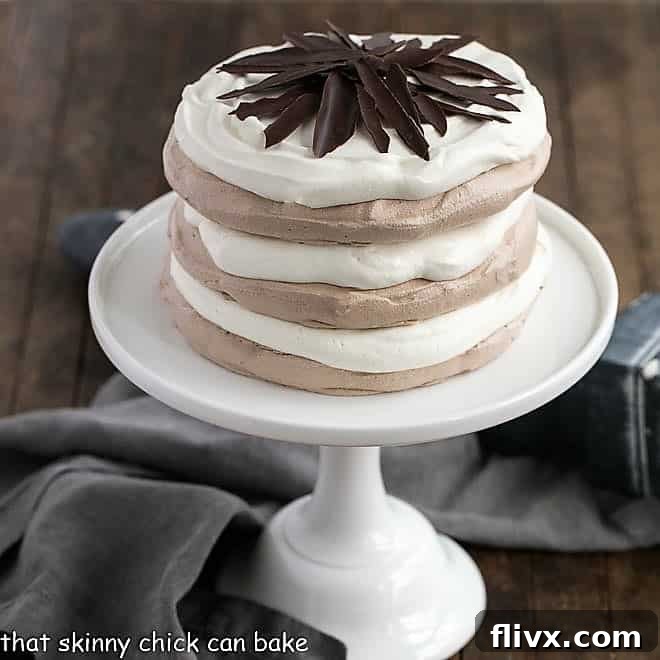
Layered Chocolate Meringue Cake
30 minutes
3 hours
3 hours 30 minutes
12 servings
Three sweet, light chocolate pavlovas layered with whipped cream for an elegant, gluten-free dessert!
Ingredients
- 6 egg whites, at room temperature
- 1 ½ cups superfine sugar (use granulated if superfine not available)
- 1 ½ tablespoons of cornstarch
- 3 tablespoons good quality cocoa powder
- 1 teaspoon lemon juice
- 2 cups heavy cream
- ½ cup powdered sugar
- 1 teaspoon vanilla extract
- Chocolate shards to garnish
Instructions
- Preheat the oven to 225ºF (107ºC). Line 3 baking sheets with parchment paper. Draw a 7-inch (18 cm) circle on each piece of parchment, then flip the paper over so the drawing is on the bottom. Set aside.
- In a small bowl, whisk together the superfine sugar and the cornstarch until well combined. Set aside.
- Using an electric mixer with a whisk attachment, beat the room temperature egg whites in a very clean bowl until they are satiny in appearance and soft peaks form. Slowly add the sugar-cornstarch mixture, about 2 tablespoons at a time, while continuing to beat. Continue beating until the meringue is stiff, glossy, and holds firm peaks. Sift the cocoa powder over the meringue, then gently fold to combine. Finally, add the lemon juice and fold briefly until just incorporated.
- Carefully divide the meringue mixture evenly among the three prepared baking sheets, spreading it within the drawn 7-inch circles. Use an offset spatula to smooth the tops and edges of each meringue disc. Place the baking sheets in the preheated oven and bake for 3 hours, or until the pavlovas are dry to the touch on the edges and top. They will likely appear cracked, which is normal for a pavlova. Turn off the oven and leave the pavlovas inside for an additional 3 hours (or even overnight) to cool down and dry out completely without opening the oven door.
- To prepare the whipped cream, combine the heavy cream, powdered sugar, and vanilla extract in a large chilled bowl. Beat with an electric mixer until stiff peaks form. To assemble, place one cooled pavlova disc on your chosen serving plate. Spread about 1 ½ cups of whipped cream evenly over the top. Carefully place the second pavlova disc on top of the cream layer, followed by another 1 ½ cups of whipped cream. Finally, top with the third pavlova disc. Garnish generously with chocolate shards, chocolate curls, or grated chocolate as desired before serving.
Notes
Ensure your mixing bowl and beaters are impeccably clean and grease-free, and that no egg yolk whatsoever contaminates your egg whites. Any fat will prevent the egg whites from whipping properly.
This recipe draws inspiration from Nigella Lawson’s classic chocolate pavlova and the elegant Chocolate-Coconut Pavlova Cake featured in Southern Living, bringing together the best elements of both.
Recommended Products
As an Amazon Associate and member of other affiliate programs, I earn from qualifying purchases.
- KitchenAid KSM150PSER Artisan Tilt-Head Stand Mixer with Pouring Shield, 5-Quart, Empire Red
- Reynolds Kitchens Non-Stick Baking Parchment Paper Sheets – 12×16 Inch, 22 Count
- USA Pan Bakeware Half Sheet Pan
Nutrition Information:
Yield:
12
Serving Size:
1 slice
Amount Per Serving:
Calories: 267Total Fat: 15gSaturated Fat: 9gTrans Fat: 0gUnsaturated Fat: 4gCholesterol: 45mgSodium: 39mgCarbohydrates: 32gFiber: 0gSugar: 31gProtein: 3g
HOW MUCH DID YOU LOVE THIS RECIPE?
Please leave a comment on the blog or share a photo on Pinterest