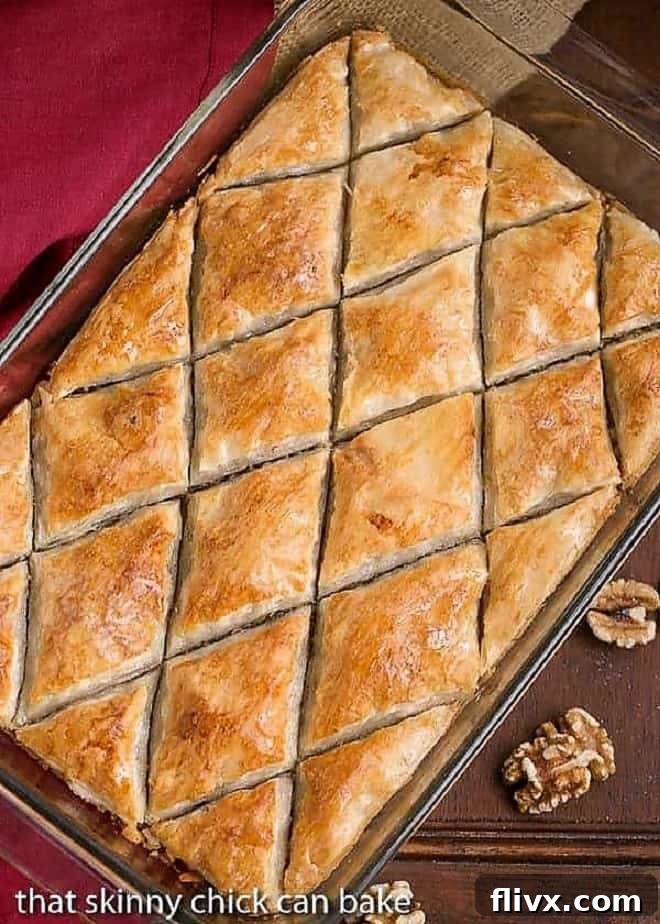
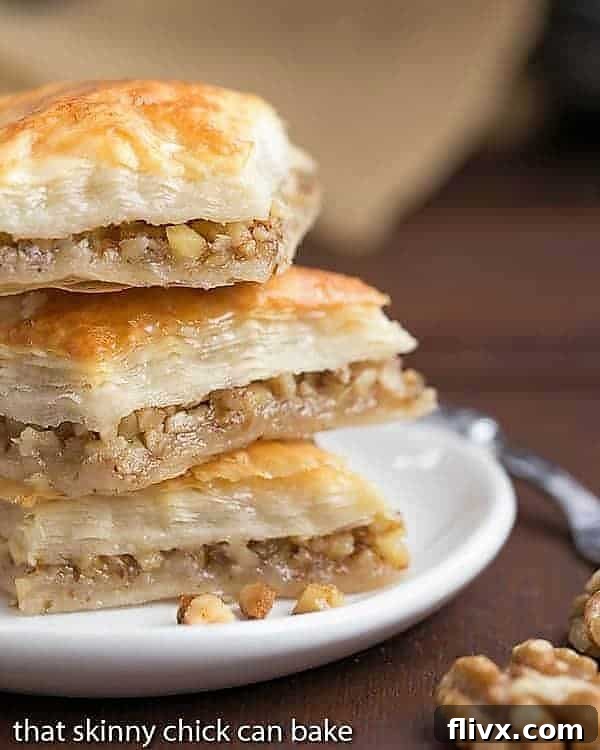
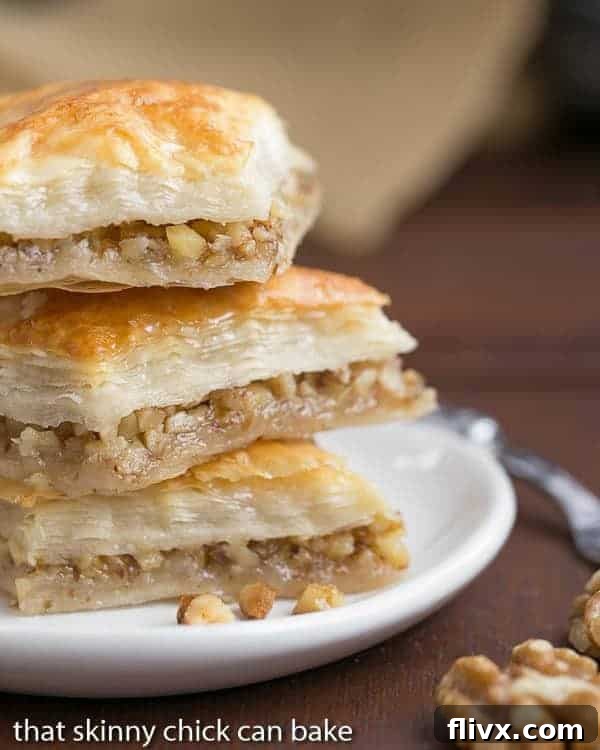
Experience the timeless allure of a truly authentic Classic Greek Baklava, a dessert so exquisite and rich, it promises to be an unforgettable culinary journey. Each delicate layer of flaky phyllo pastry, generously filled with a symphony of crunchy nuts, and bathed in a fragrant orange blossom water-infused syrup, crafts a treat that has charmed palates for centuries. This isn’t just any dessert; it’s a taste of tradition, often reminiscent of cherished family memories. My own mother, a true force in the kitchen, created this magnificent baklava dessert, leaving an indelible mark on our family’s culinary heritage with every delicious, memorable bite. Now, you can recreate that magic in your own home.
For those new to the art of baking with the incredibly thin sheets known as filo, fillo, or phyllo dough, don’t be intimidated! This ancient pastry is remarkably versatile, and with the expert tips provided further down, you’ll soon master its delicate nature. Once you unlock the secrets to handling phyllo, this delightful Baklava Recipe will not only become a new favorite in your repertoire but a treasured family tradition, bringing joy and sweetness to any occasion.
Why You Need to Make This Classic Baklava Recipe
There are countless reasons to embark on the delicious adventure of making your own baklava. This traditional Greek dessert, with its intricate appearance and luxurious taste, is more achievable than you might think and offers immense rewards:
- Impress Your Guests: Imagine the awe and delight on the faces of your friends and family when you present a tray of homemade baklava! Telling them you crafted this exquisite dessert from scratch is sure to earn you endless compliments and admiration.
- Easier Than It Looks: Many people perceive baklava as an incredibly complex dessert to prepare, but it’s genuinely simpler than its elegant presentation suggests. If you’re a beginner with phyllo dough, rest assured that our detailed tips and step-by-step guide will demystify the process, making this an accessible and rewarding baking project.
- A Nut Lover’s Dream: If you adore the rich, earthy flavors and satisfying crunch of nuts, then this baklava is an absolute must-make. Bursting with a generous filling of finely chopped walnuts, each bite delivers a delightful nutty essence perfectly balanced by the sweet, aromatic syrup.
- A Taste of Tradition: Baklava is more than just a dessert; it’s a culinary legacy steeped in history and culture. By making it yourself, you connect with generations of bakers and bring an authentic piece of Mediterranean tradition into your home.
- Perfect for Any Occasion: Whether for a holiday gathering, a special celebration, or simply as an indulgent treat for yourself, homemade baklava elevates any moment. It’s a versatile dessert that always leaves a lasting impression.
My childhood was a unique blend of small-town charm and global influences, largely thanks to my upbringing in Ames, Iowa – a small university town nestled in the heart of the Midwest. While it might seem “in the middle of nowhere,” the university served as a vibrant hub, attracting brilliant minds and diverse cultures from around the world. This academic environment enriched our lives immensely; we’d regularly enjoy symphonies, theatrical performances, and spirited football games, often cheering on university students who were also the star performers.
Beyond the campus activities, my parents cultivated friendships with people from every corner of the globe. This extraordinary exposure wasn’t just about different languages or customs; it was a gateway to new cuisines. Our dinner table often featured dishes from various cultures, broadening our palates and igniting a lifelong passion for international flavors. It was in this melting pot of experiences that my appreciation for desserts like baklava truly began, making its journey from exotic delicacy to a cherished homemade staple.
Essential Ingredient Notes for Perfect Baklava
Crafting the perfect Classic Greek Baklava requires a careful selection of core ingredients. Understanding each component’s role will not only improve your baking but also allow for delicious experimentation.
- Filo (or Phyllo) Dough: This is unequivocally the star of baklava. Originating from the Greek word for “leaf,” filo is a paper-thin, unleavened pastry dough that forms the signature crispy, flaky layers of baklava. It’s incredibly delicate, requiring gentle handling, but yields an unparalleled texture. You’ll typically find it in the frozen foods section of your grocery store, often near puff pastry. For best results, ensure it’s fully defrosted before use, following package instructions.
- Nuts: While the type of nut can vary across different regional baklava recipes, they are absolutely non-negotiable for its authentic taste and texture. This recipe traditionally calls for walnuts, which impart a rich, slightly earthy flavor and satisfying crunch. However, feel free to experiment with other nuts like pistachios (common in Turkish and Middle Eastern versions for their vibrant color and distinct flavor), almonds, or even hazelnuts for a delightful twist. For optimal flavor, toast your nuts lightly before chopping.
- Sweet Sugar Syrup: This luscious syrup is what transforms dry pastry and nuts into a moist, sweet, and aromatic dessert. Often, baklava syrups include honey, but many Turkish and some Greek versions, like this one, rely solely on sugar. The magic truly happens with the flavoring: a generous splash of orange flower (or orange blossom) water imparts a subtle, floral, and deeply aromatic essence that is utterly captivating and distinctive. Other options include rosewater, cinnamon sticks, or lemon zest for varied aromatic profiles. Crucially, the syrup must be cold when poured over the hot, freshly baked baklava to achieve the ideal absorption and crispness.
- Butter (or Olive Oil): To create those irresistible flaky layers, each sheet of phyllo dough is brushed with melted fat. Unsalted butter is the traditional choice, lending a rich, golden flavor and incredible crispness. Clarified butter (ghee) is often preferred by seasoned bakers as it prevents the pastry from burning as quickly and yields an even flakier result. While butter is supreme, some regional variations or dietary preferences may utilize olive oil, which offers a slightly different, fruitier flavor profile.
Mastering Phyllo Dough: Essential Expert Tips
Working with phyllo dough can seem daunting at first due to its delicate nature, but with a few key techniques, you’ll find it incredibly manageable and rewarding. These expert tips will ensure your Classic Greek Baklava turns out perfectly crispy and delicious every time:
- Proper Defrosting is Key: Phyllo dough is almost always found in the freezer aisle. Always follow the package instructions for defrosting. The best method is usually a slow overnight defrosting in the refrigerator. Avoid quick defrosting at room temperature or in the microwave, as this can cause the sheets to stick together or become brittle.
- Keep it Covered, Always: Phyllo dries out incredibly fast when exposed to air, becoming brittle and prone to shattering. Do not remove the phyllo from its plastic wrapping until all your other ingredients – melted butter, chopped nuts, prepared syrup – are fully prepped and ready for assembly.
- PRO-Tip: The Damp Towel Method: Once you’re ready to start layering, carefully remove the phyllo from its packaging and unroll it onto a clean, dry work surface. Immediately cover the stack of phyllo sheets with a sheet of plastic wrap, and then cover the plastic wrap with a lightly damp, clean kitchen towel. This creates a humid environment that keeps the phyllo pliable. Uncover only to remove one sheet at a time, then re-cover quickly.
- Work Quickly and Confidently: Speed is your friend when working with phyllo. While you don’t need to rush to the point of making mistakes, working efficiently will minimize the time the phyllo is exposed to air. Don’t linger too long between layers.
- Liberal Brushing: Don’t skimp on the butter (or oil)! Each layer of phyllo needs to be generously brushed to ensure maximum flakiness and golden-brown perfection. Since the exterior edges are most susceptible to drying, brush around the perimeter of each sheet first. Use a soft pastry brush to minimize any tearing.
- PRO-Tip: Don’t Fear Tears: It’s almost inevitable that a sheet or two of phyllo will tear while you’re working with it. Don’t panic! These torn sheets are perfect for the middle layers of your baklava. Simply patch them together as best you can, brush with butter, and continue layering. Once baked, no one will be able to tell, as there will be plenty of intact layers above and below.
- Pre-Cutting is Crucial: Before baking, baklava is typically cut into its characteristic diamond or square shapes. This pre-cutting allows the butter and syrup to penetrate all the layers evenly, ensuring a moist and flavorful dessert. Use a sharp, thin knife for clean cuts.
- Store Leftovers Properly: If you have any unused phyllo dough, wrap it tightly in plastic wrap and then in aluminum foil, or place it back in its original box and an airtight bag. Store it in the freezer for up to 3 months.
Step-by-Step: How to Make Irresistible Classic Baklava
Making baklava is a delightful process that, while requiring a bit of patience, is far from difficult once you grasp a few key techniques. The secret to success lies in careful preparation and understanding the delicate nature of phyllo. Here’s a comprehensive guide on how to make baklava that will yield a truly heavenly dessert:
- Prepare Your Ingredients and Workspace: Before you even unroll the phyllo, ensure all your components are ready. Chop your nuts to your desired coarseness, making sure your phyllo is fully defrosted in the refrigerator. Have your melted butter (or olive oil) ready, and crucially, prepare your damp tea towel to cover the phyllo. The sugar syrup should be made ahead of time and chilled in the refrigerator so it’s perfectly cold when needed.
- Butter the Baking Pan: Generously melt your unsalted butter. Using a pastry brush, thoroughly grease the bottom and sides of your 9×13-inch baking pan. This prevents sticking and contributes to a beautiful, golden crust.
- Combine the Nut Filling: In a medium bowl, mix together your coarsely chopped walnuts (or other preferred nuts) with the granulated sugar. You can also add a pinch of cinnamon or a dash of cloves for extra warmth and flavor, though it’s optional for a classic Greek profile. Set this mixture aside.
- Mastering the Phyllo Layers (First Half):
- PRO-Tip: Protect Your Phyllo: Carefully open your phyllo package. Immediately cover the stack of pastry sheets with the plastic or parchment from the box, then top it with a lightly damp, clean tea towel. This is vital to prevent the phyllo from drying out and becoming brittle.
- Begin by placing a single sheet of phyllo into the prepared baking pan. Gently brush its entire surface with melted butter. Repeat this process, layering about half of your total phyllo sheets, brushing each individual layer generously with butter. Don’t worry if the first few sheets tear a little; they’ll be hidden in the middle!
- Spread the Nut Filling: Once you’ve laid down the first half of the phyllo layers, evenly spread the entire nut and sugar mixture over the buttery phyllo surface. Ensure an even distribution for uniform flavor in every bite.
- Complete the Phyllo Layers (Second Half): Continue the layering process with the remaining phyllo sheets. Just as before, place one sheet at a time over the nut filling, meticulously brushing each layer with melted butter. Be diligent, ensuring even coverage right up to the edges.
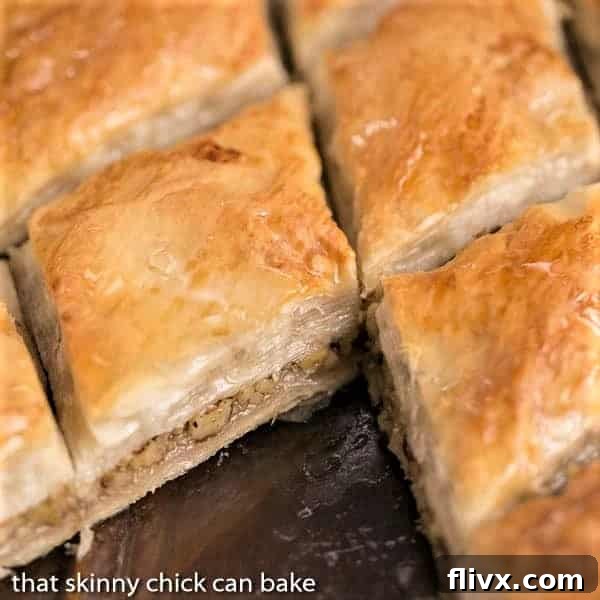
- Pre-Cutting for Perfection: This step is essential for both even baking and ease of serving. Before placing the baklava in the oven, use a sharp, thin knife to carefully cut the baklava all the way through to the bottom of the pan. Traditionally, baklava is cut on the diagonal in one direction, then the other, to form distinctive diamond (or lozenge) shapes. Alternatively, you can cut it into squares.
- Bake to Golden Perfection: Preheat your oven to 350°F (175°C). Bake the baklava as directed (typically around 30-45 minutes at 350°F, potentially increasing temperature towards the end for extra crispness). Keep an eye on it; you’re looking for a beautiful, puffed, and golden-brown top. The edges should be deeply golden and fragrant.
- The Syrup Drench (The Grand Finale): As soon as the baklava comes out of the oven, immediately and evenly pour the thoroughly chilled sugar syrup over the entire hot pastry. You’ll hear a satisfying sizzle as the cold syrup meets the hot baklava, which helps create that unique texture and ensures maximum absorption. Allow the baklava to cool completely to room temperature – this is crucial for the syrup to fully penetrate and for the layers to set into that perfect crisp-tender consistency.
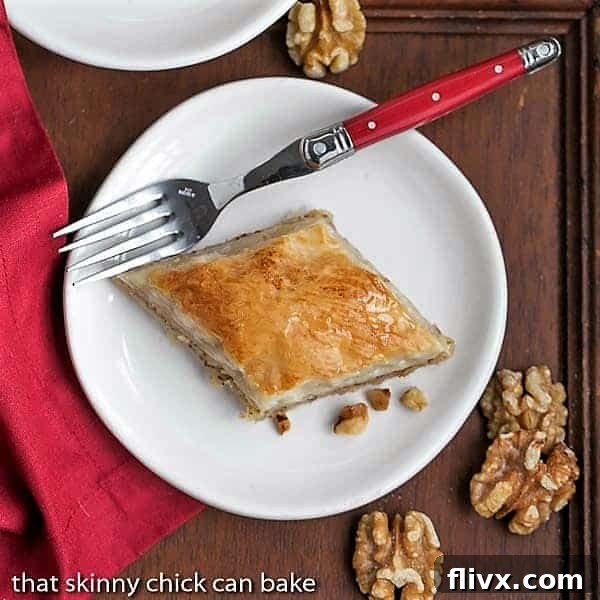
- Serve and Enjoy: Once fully cooled, your Classic Greek Baklava is ready to be served. Dig in and savor the heavenly combination of crisp phyllo, sweet nuts, and aromatic syrup!
Frequently Asked Questions About Baklava
Here are some common questions about baklava, its origins, ingredients, and storage:
Baklava is a rich, sweet dessert pastry primarily composed of many layers of paper-thin phyllo dough, generously filled with chopped nuts (most commonly walnuts or pistachios), and sweetened with a syrup, often flavored with honey, sugar, rosewater, or orange blossom water. The combination of crispy layers and moist, sweet filling makes it a truly unique and indulgent treat.
The precise origin of baklava is a subject of historical debate, but it is widely believed to have roots in the ancient Middle East and Mediterranean regions. Its earliest forms can be traced back to Assyrian times. However, the baklava as we know it today, with its multi-layered phyllo, is most strongly associated with the Ottoman Empire. From there, it spread across the vast territories of the empire, influencing cuisines in the Levant, South Caucasus, Southeast Europe (including Greece and the Balkans), Maghreb, and Central Asia. Each region has since developed its own unique variations.
Filo, also spelled phyllo or fillo, is a type of unleavened dough used for making pastries in Middle Eastern and Balkan cuisines. The name “filo” comes from the Greek word φύλλο, meaning “leaf,” which perfectly describes its incredibly thin, delicate, and transparent sheets. Because of its extreme thinness, phyllo dries out very quickly when exposed to air, becoming brittle and difficult to work with. Therefore, extra care, like keeping it covered with a damp towel, is essential when using phyllo in recipes such as this classic baklava, savory börek, traditional spanakopita, apple strudel, or tiropita. Once you master handling this delicate dough, you’ll discover that making baklava is an surprisingly easy baklava recipe!
Baklava is quite forgiving when it comes to storage, and it often tastes even better the next day after the flavors have had a chance to meld.
At Room Temperature: If your kitchen is not excessively warm, baklava can be stored in an airtight container at room temperature for up to two weeks. Keep it away from direct sunlight.
In the Refrigerator: During warmer months, or for extended freshness, it’s best to keep baklava in an airtight container in the refrigerator for up to two weeks. The syrup may crystallize slightly in the cold, but it will soften once it comes to room temperature.
Freezing Baklava: Yes, baklava freezes beautifully! Ensure it is completely cool before freezing. Place individual pieces or layers separated by wax or parchment paper in an airtight freezer-safe container. It can be frozen for up to four months. To enjoy, simply defrost overnight in the refrigerator, and bring to room temperature before serving.
Absolutely! Baklava is an excellent make-ahead dessert. In fact, many believe it tastes even better a day or two after it’s made, as the syrup has more time to fully soak into all the layers, resulting in a more uniform texture and richer flavor. Store it as directed above.
Explore More Delicious Dessert Recipes
If you’ve enjoyed making this Classic Greek Baklava, you might be interested in trying some of these other delightful dessert recipes:
- Double Chocolate Nutella Toffee Skillet Brownie from Country Cleaver – A rich and indulgent brownie baked in a skillet.
- Pecan Tassies – Also known as mini pecan pies, these bite-sized treats are perfect for parties.
- Old Fashioned Pecan Pie – A timeless classic, perfect for any gathering.
- Toffee Cookies with Walnuts – Chewy cookies packed with crunchy toffee and walnuts.
- White Chocolate Macadamia Nut Cookies – A classic cookie combination that’s always a hit.
- Plus, you must check out my comprehensive Dessert Recipes and Bar Cookie Recipes categories for even more inspiration to satisfy your sweet tooth!
We love connecting with fellow bakers and food enthusiasts! Stay in touch through social media by following @thatskinnychickcanbake on Instagram, Facebook, and Pinterest. Don’t forget to tag me when you try one of my recipes – I love seeing your delicious creations! And if you absolutely love the results of this baklava, please consider giving it a 5-star rating in the recipe card below to help other home cooks discover this amazing dessert.
Classic Baklava Recipe
20 minutes
30 minutes
50 minutes
24 servings
A traditional Greek dessert that you can now make at home! Layers of crispy phyllo, rich walnuts, and fragrant orange blossom syrup.
Rating: 5 out of 5 stars (Based on 55 reviews)
Ingredients
For the Aromatic Syrup:
- 1 cup granulated sugar
- ½ cup water
- 1 tablespoon fresh lemon juice
- 1 tablespoon orange blossom water (also known as orange flower water)
For the Baklava Layers:
- 1 pound (approx. 450g) frozen phyllo dough, defrosted according to package directions
- 1 cup unsalted butter, melted (for brushing layers)
- 6-8 ounces (approx. 170-225g) walnuts, coarsely chopped
- 2 tablespoons granulated sugar (for nut mixture)
Instructions for Classic Baklava
- Prepare the Syrup: In a small saucepan, combine 1 cup sugar and ½ cup water. Bring to a boil over medium heat, stirring until the sugar is completely dissolved. Reduce heat to low and simmer gently for about 5 minutes until the syrup slightly thickens to a consistency that coats the back of a spoon. Remove from heat, stir in the lemon juice and orange blossom water, and simmer for another 2 minutes. Pour the syrup into a heatproof bowl or jar and chill completely in the refrigerator until cold.
- Prep the Pan and Phyllo: Preheat oven to 350ºF (175ºC). Brush a 9×13 inch baking pan generously with some of the melted butter. Unroll your defrosted phyllo dough. Place half of the phyllo sheets into the pan, one sheet at a time, brushing each layer thoroughly with melted butter before adding the next.
- Protect Your Phyllo: While you are working, keep the unused phyllo sheets covered with their original plastic/parchment and a damp tea towel. This prevents them from drying out and becoming brittle. Don’t worry if a sheet tears – simply use it in a middle layer; it will not affect the final taste or appearance.
- Add the Nut Filling: In a separate bowl, mix the coarsely chopped walnuts with 2 tablespoons of sugar. Once half of the phyllo layers are in the pan, spread this nut and sugar mixture evenly over the buttery phyllo surface.
- Complete the Layers: Continue layering the remaining phyllo sheets over the nuts, brushing each individual sheet generously with melted butter as before. Ensure the top layer is well-buttered for a beautiful golden crust.
- Cut the Baklava: Using a very sharp knife, carefully cut the baklava into diamond (lozenge) shapes or squares all the way through to the bottom of the pan. Cut diagonally in one direction, then the other, to create the classic diamond pattern.
- Bake: Bake the baklava in the preheated oven at 350ºF (175ºC) for 30 minutes. Then, increase the oven temperature to 450ºF (230ºC) and bake for another 10-15 minutes, or until the top is beautifully puffed and deeply golden brown. Watch it closely to prevent burning.
- Pour the Cold Syrup: Immediately upon removing the hot baklava from the oven, evenly pour the completely cold sugar syrup over the entire surface. You’ll hear a wonderful sizzle as the syrup absorbs into the hot layers.
- Cool and Serve: Allow the baklava to cool completely to room temperature before serving. This allows the syrup to fully penetrate and the layers to set, resulting in the perfect crisp-tender texture.
Chef’s Notes
Feel free to customize your baklava by using different nuts! Pistachios, hazelnuts, or almonds can all be used instead of walnuts, offering unique flavor profiles. You can also add a pinch of ground cinnamon or cloves to your nut mixture for an extra layer of spice.
Watch the video below to see how easy it is to make this delightful Classic Baklava Recipe!
Recommended Baking Products
As an Amazon Associate and member of other affiliate programs, I earn from qualifying purchases, helping to support this blog.
- Orange Blossom Water
- Silicone Pastry Brush
- 9 x 13 Revol Ceramic Baking Dish
Nutrition Information:
Yield:
24 servings
Serving Size:
1 piece
Amount Per Serving (approximate):
Calories: 559
Total Fat: 49g
Saturated Fat: 10g
Trans Fat: 0g
Unsaturated Fat: 37g
Cholesterol: 20mg
Sodium: 80mg
Carbohydrates: 27g
Fiber: 4g
Sugar: 11g
Protein: 9g
HOW MUCH DID YOU LOVE THIS RECIPE?
Please leave a comment on the blog with your thoughts, or share a photo of your beautiful baklava on Pinterest!